Silphium mohrii
| Silphium mohrii | |
|---|---|
| Scientific classification | |
| Kingdom: | Plantae |
| Clade: | Tracheophytes |
| Clade: | Angiosperms |
| Clade: | Eudicots |
| Clade: | Asterids |
| Order: | Asterales |
| Family: | Asteraceae |
| Tribe: | Heliantheae |
| Genus: | Silphium |
| Species: | S. mohrii
|
| Binomial name | |
| Silphium mohrii | |
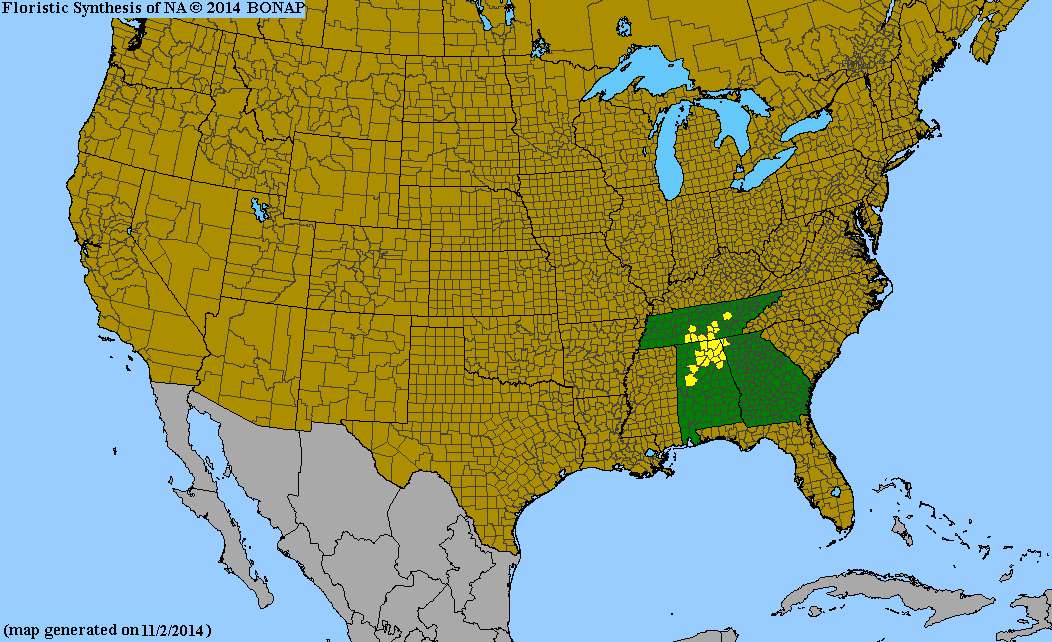
Silphium mohrii, known by the common names Mohr's rosinweed[2] and shaggy rosinweed, is a species of flowering plant in the family Asteraceae. It is native to the Southeastern United States, where it is native only to northern Alabama, southern Tennessee, and extreme northwest Georgia.[3][4] It occurs in prairie remnants and rocky limestone openings, often in open, dry habitats with thin soils. Because of its restricted range and severely declined habitat, it is considered a vulnerable species.
It produces heads of yellow flowers in late summer, typically flowering from August to September.[5]
The species was first described by John Kunkel Small in 1897.[4]
Description
Silphium mohrii is a tall perennial distinguished by its densely shaggy-hirsute stems, inflorescence, and phyllaries, with hairs often exceeding 5 mm in length. The inflorescence is typically corymbose, bearing multiple flower heads (generally 3–15).[5]
It is most similar to other Silphium species with non-pinnatifid leaves, but can be distinguished by its long, shaggy pubescence and multi-headed inflorescence.[5]
Taxonomy
The species was first described by John Kunkel Small in 1897. In a 1999 revision of Silphium, Jennifer Ann Clevinger treated S. mohrii within Silphium sect. Silphium, a group characterized by fibrous roots and caulescent growth.[6]
References
- ^ "Silphium mohrii". NatureServe. Retrieved 17 September 2024.
- ^ NRCS. "Silphium mohrii". PLANTS Database. United States Department of Agriculture (USDA). Retrieved 15 November 2015.
- ^ Kartesz, John T. (2014). "Silphium mohrii". County-level distribution map from the North American Plant Atlas (NAPA). Biota of North America Program (BONAP). Retrieved 17 March 2015.
- ^ a b "Silphium mohrii Small". Plants of the World Online. Royal Botanic Gardens, Kew. Retrieved 18 March 2026.
- ^ a b c "Silphium mohrii". Flora of the Southeastern United States. Retrieved 18 March 2026.
- ^ Clevinger, Jennifer Ann (1999). Systematics of Silphium and its subtribe Engelmanniinae (Asteraceae: Heliantheae) (PhD thesis). The University of Texas at Austin.